
Concrete products are loved for their durability and beautiful that makes them a favorite choice for patios, driveways, and walkways. However, even the strongest materials can show signs of wear over time, and one of the most common issues homeowners notice are paver stains. From mysterious marks that appear after a rainfall to stubborn spots left behind by everyday use, stains can affect the overall look of your outdoor space. The good news is that there are simple ways to both remove paver stains and keep them from coming back. In this guide, we’ll explain the most common causes of staining and share effective tips on how to prevent paver stains so your hardscape stays beautiful for years to come.
Natural paver stains
By natural stains we mean, residues left by the natural environment from things such as moss and tree leaves.
Moss
Moss develops with long periods of humidity and is made worse when the surface has no direct sun exposure. To avoid it, cut the shrubs and branches that create unnecessary shade. If moss has already developed, start by removing it with a pressure washer. You can also try scrubbing the surface with a broom or a scrub brush.
Pro tip: Be careful not to scrub too hard to leave scratch marks on the pavers.
Petals and Fallen Leaves
In autumn, fallen leaves may land on your pavers and can leave behind brown-ish stains. Since concrete is porous it easily absorbs the pigments in flowers and leaves. It is important to regularly broom the surface to avoid these paver stains, especially before the winter season arrives.
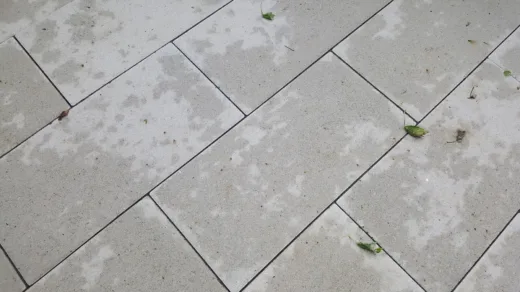
The fallen leaves on these light-colored pavers will surely cause stains if they are not removed quickly.
Rust stains
Rust stains do not have anything to do with the quality of the concrete products. In fact, rust stains are caused by steel and/or fertilizers.
Drops of Rusted Water
You’ll notice, once you move your outdoor furniture drops of rusted water will damage the surface of your pavers quickly. If this happens, hose down the drops of rust with water immediately to avoid it from staining permanently.
Also, be sure to clean your gutters, add an extension, and properly position it to avoid draining of dirty water on your pavers.
Streaks of Metal
The dragging of metal objects on the surface of your pavers can leave rust colored streaks. When winter comes, avoid metal shovels; Choose small plastic shovels instead.
Pro tip: verify that your snow removal company uses the appropriate equipment with Teflon protection. For more information on preparing your pavers for winter check out this post.
Fertilizer Spots
Fertilizers contain iron, which is what causes the rust effect on concrete products. So, if you notice round rust-colored spots after the application of fertilizer on your grass, you now know where it comes from! It’s important to remove the fertilizer particles with a broom immediately after it is applied to avoid them from expanding and creating paver stains.
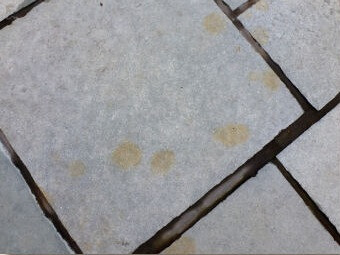
An example of fertilizer stains on pavers
To clean all the rust stains mentioned above, you can apply a rust remover.
Oil and Grease stains
Oil and grease paver stains can be tough.
Motor Oil
If you notice that your car is leaking, it is recommended to quickly clean the pavers with a de-greaser to avoid the stains soaking in. The faster you catch the leak, the more likely it is to be removed.
Grease
During BBQ season, it’s possible for grease stains to end up around your outdoor kitchen area. To clean these paver stains, you can apply some dish soap. For the tougher stains, use a degreaser that dissolves, captures and removes the stains.
Rubber Stains
It's not rare for tire tracks to end up on driveway pavers. They’re especially visible on light-colored pavers. To easily remove the rubber marks, brush the surface and then clean with the help of a pressure-washer. If that doesn’t work, apply rubber and paint stain remover.
De-icing Salts
It is important to use de-icing salts BEFORE ice has formed on the surface. Do not use de-icing salts AFTER ice has already formed as it can cause the erosion of the surface of your pavers. We strongly recommend using gravel or sand for icy areas.
To try to avoid all the paver stains mentioned above, you can apply a product sealer specially created to protect your pavers. Its made to halt the penetration of contaminants and facilitate the maintenance of pavers. In hopes that these tips will help you preserve the natural beauty of your pavers!
*We recommend testing cleaning products on a small section of your pavers before applying it to the entire surface. Follow the instructions of the manufacturer. You can find equivalent paver stain removers at your local hardware store.
**Equivalent product cleaners and sealers can be found at your local hardware store.
Cleaning Salt Stains
When ice forms on your pavement, it is essential not to use de-icing salts. These can cause the surface of your pavement to crumble and flake.
To prevent any stains on your pavement, including those mentioned above, you can apply a protective product specially designed for concrete pavers. Its film slows down the penetration of contaminants, making maintenance of the material easier.
Removing Tar and Rubber Stains
It is not uncommon to see tire marks in parking lots and driveway entrances, especially on light-colored pavers. To easily remove rubber traces, start by sweeping thoroughly. Then, brush and clean the surface of your pavement using a high-pressure water jet.
Alternatively, to facilitate the cleaning process, stripping products can be used. They will effectively dissolve paint, tar, or rubber stains.
Maintenance of Interlocking Pavement in Summary
We hope these maintenance tips will help you preserve the nature of your pavement, whether it is soiled by leaves, oil, corrosive agents causing rust, or other substances.
We also recommend always testing all cleaning products on a small area of your pavement before applying them to the entire area. Be sure to read the manufacturer's directions and instructions carefully.
You can find cleaners and various sealants at hardware stores near you.
Need ideas to redo your parking lot? We have what you need to create an incomparable and impressive paved entrance.